
CPR and Defibrillator Training: Which Course Do You Need?

CPR and defibrillator training helps people recognise a life-threatening emergency, summon help and provide practical assistance while an ambulance is on its way. The difficult part is not deciding whether those skills matter. It is working out which course fits the people you may need to help and the setting in which you are likely to act.
An adult-only course may be entirely appropriate for someone responsible for colleagues in an office or members of an adult community group. A parent, youth leader or volunteer working at a family event may want training that also covers children and infants. Other learners need anaphylaxis included because severe allergic reactions form part of the risks they are preparing to manage.
DTMK therefore offers several community CPR, basic life support and defibrillator courses. Some concentrate on adults, others cover all age groups, and selected courses include anaphylaxis. Broader first aid options prepare learners for injuries and medical emergencies beyond CPR.
This guide will help individuals, families, volunteers and organisations choose a course that reflects their real responsibilities, rather than relying on whichever title sounds most comprehensive.
Why CPR Courses Are Not All the Same
Course titles can appear remarkably similar. CPR, basic life support and automated external defibrillation are closely connected, but the intended audience, age groups covered, qualification level and additional subjects can differ. An extra phrase in a course title can represent an important change in what learners practise.
Basic life support, often shortened to BLS, focuses on the immediate response when a person is unresponsive and may not be breathing normally. CPR is central to it. An automated external defibrillator, usually called an AED or defibrillator, analyses the heart rhythm and provides prompts. Current Resuscitation Council UK adult basic life support guidance emphasises that everyone can learn CPR and anyone can use an AED.
Training remains valuable even though an AED is designed to guide its user. A real emergency rarely feels as tidy as a demonstration. People must recognise that something is seriously wrong, call 999, begin acting and work with whoever else is nearby. Practical training gives learners the opportunity to handle equipment, rehearse decisions and discover what they find difficult before somebody’s life depends on their response.
Age range matters too. The principles of early recognition, calling for help, CPR and prompt defibrillation remain connected, but the practical approach is not identical for adults, children and infants. Someone who regularly works around families may reasonably want to practise across all three age groups rather than relying on an adult-only programme.
Anaphylaxis introduces another distinct emergency. It is a serious allergic reaction that can affect a person’s airway, breathing or circulation and requires urgent recognition and action. Including anaphylaxis alongside BLS and AED training creates a focused programme for people who want to prepare for two different time-critical emergencies without completing a broad workplace first aid qualification.
One Course for Adults, Children, Infants and Anaphylaxis
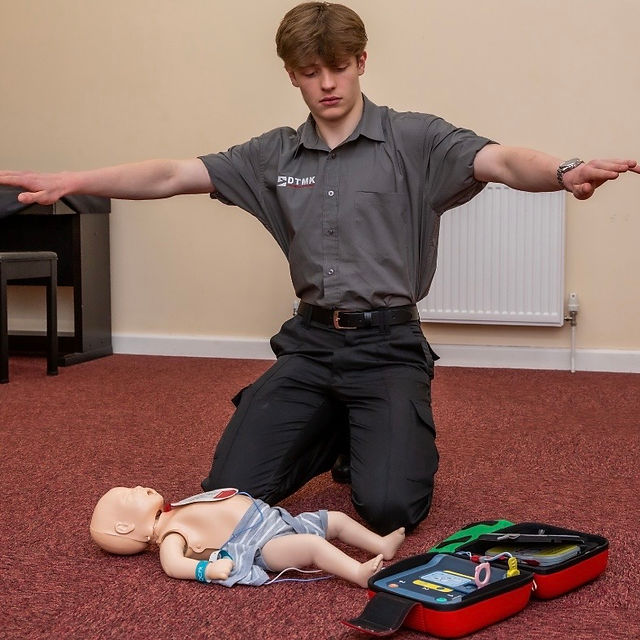
For learners who want the broadest coverage within a focused half-day community programme, DTMK’s BLS, AED and Anaphylaxis for Adults, Children and Infants course is the natural starting point.
This is the Qualsafe Level 3 Award in Basic Life Support, Automated External Defibrillation and Management of Anaphylaxis for Adults, Children and Infants. It is an Ofqual-regulated qualification with three-year certification. The course brings together adult, child and infant BLS and AED practice with the recognition and management of anaphylaxis, including the appropriate use of an adrenaline auto-injector.
The combination makes sense for people whose lives do not stay inside one neat age category. A community volunteer might support adults at one event and families at another. A sports club may have adult coaches, teenage participants and younger siblings around the venue. A grandparent may want practical confidence with an infant but also be the person present if another adult collapses.
This is also the course DTMK currently has scheduled for public attendance at its Milton Keynes training centre. Individuals and smaller groups can therefore reserve places without having to organise a complete private course. The published session is four and a half hours and is currently priced at £69 per learner. As dates, availability and prices can change, readers should check the live booking page before making arrangements.
The course is deliberately focused and is not a substitute for every form of first aid training. Its strength is the way it concentrates practical time on BLS, defibrillation and anaphylaxis across all age groups.


When an Adult-Only CPR and AED Course Is Enough
Not everyone needs training across all ages. If the people you are likely to assist are adults and your main aim is to learn CPR and defibrillator use, an adult course may provide a more direct route.
DTMK’s CPR and AED Training leads to the Qualsafe Level 2 Award in Cardiopulmonary Resuscitation and Automated External Defibrillation. It is a regulated course covering basic life support, the recovery position, CPR, choking and the safe use of a defibrillator. Its certification is valid for one year, so the renewal pattern differs from several of the Level 3 BLS qualifications.
The Level 3 Adult Basic Life Support and AED course is another focused adult option. It concentrates on adult CPR, safe AED use, the unconscious casualty and relevant BLS and AED considerations. It carries three-year certification and may suit members of the public, volunteers and community groups who want a regulated adult BLS qualification. It can also help people refresh practical skills during the life of a longer first aid qualification, although it does not extend or replace that qualification.
These courses overlap, but they are not identical. The Level 2 qualification has a one-year certification period and includes subjects such as choking and the recovery position. The Level 3 adult BLS and AED programme has three-year certification. The right choice depends on the training requirement and the emergencies the group wants to cover.
If anaphylaxis is a relevant risk but the learner only needs adult BLS, DTMK also offers Adult BLS, AED and Anaphylaxis Training. This regulated Level 3 option adds the recognition and management of anaphylaxis to adult CPR and AED practice. It can suit adult community groups, volunteers or organisations where severe allergic reactions form part of the foreseeable emergency picture, but child and infant resuscitation are not required.
Choosing All-Ages BLS Without the Anaphylaxis Module
Some learners want practical BLS and defibrillator training for adults, children and infants but do not need anaphylaxis included in the same qualification. The BLS and AED for Adults, Children and Infants course provides that route.
This regulated Qualsafe Level 3 qualification covers CPR and safe AED use across all three age groups, together with the unconscious casualty and relevant BLS considerations. It is a half-day course with three-year certification for mixed-age environments and individuals wanting broader coverage than an adult-only programme.
Both all-ages programmes cover adult, child and infant BLS and AED skills. The featured course also includes anaphylaxis, so the choice should begin with the learner’s real circumstances rather than the longer title.
If a club, group or organisation already has robust allergy arrangements and only wants a focused resuscitation qualification, the BLS and AED course may meet its intended training outcome. If learners need to recognise and respond to severe allergic reactions as well, the combined all-ages BLS, AED and anaphylaxis qualification offers the more coherent package.
When You Need Broader First Aid Rather Than BLS Alone
CPR and defibrillator training prepares people for a particularly urgent emergency, but not every incident is a cardiac arrest. Bleeding, shock, burns, seizures, choking and minor injuries may be more likely in some homes, clubs and community settings. That does not make a focused BLS course inadequate. It means the training decision should begin with the situations learners are trying to prepare for.
The First Aid Essentials course offers a broader one-day programme. Alongside CPR and defibrillation, it covers incident assessment, the recovery position, choking, seizures, shock, external bleeding and a selection of minor injuries. It may suit people who want useful everyday first aid knowledge without taking a workplace qualification designed around an employer’s statutory first aid arrangements.
For sports, outdoor programmes and organised activities, the Activity First Aid course goes further. This two-day regulated qualification addresses injuries and medical situations associated with activity-based environments, including head, neck and back injuries, fractures, temperature-related conditions and other subjects beyond a focused resuscitation course.
The Qualsafe Level 2 Award in citizenAID has a different purpose again. It is intended to help members of the public respond during serious incidents where immediate actions may be needed before emergency services can reach everyone. It should be considered for its particular emergency-preparedness purpose rather than treated as another name for a conventional CPR course.
Families may prefer training designed around learning together. The DTMK Family First Aid course introduces practical emergency skills in a supportive environment for parents, grandparents, teenagers and other family members. Similarly, DTMK First Aid for Young People is designed for learners aged ten and above, including schools, sports teams, youth organisations and community groups that want age-appropriate, practical training.
These wider programmes matter because “Which CPR course?” is sometimes the wrong first question. A learner may begin by thinking about defibrillators and then realise that their concerns also include bleeding, choking, seizures or sports injuries.
Community Training, Workplace Training, Paediatric Training or Clinical BLS?
Community courses are flexible options for individuals, volunteers, families and groups, but they do not remove the need to identify training required for a particular role. A person can gain valuable, regulated life-saving skills from a community BLS course without that course automatically satisfying every workplace, childcare or clinical requirement.
Employers selecting designated first-aider training should begin with their first aid needs assessment and the Workplace First Aid Courses page. Emergency First Aid at Work, First Aid at Work, requalification and specialist workplace options have different purposes from a focused community BLS programme.
Nurseries, childminders and early-years professionals should review the Paediatric First Aid Courses page. An all-ages BLS course provides valuable practical training, but it is not automatically a substitute for a paediatric first aid qualification required by a role, setting or regulatory framework.
Healthcare and clinical teams should use the Clinical BLS Training page to identify training aligned with their professional environment and organisational requirements. Clinical learners may need content, assessment or renewal arrangements that differ from a community qualification, even where CPR and AED skills appear in both.
This distinction prevents a useful course from being asked to do a job it was not designed to do. When the requirement is unclear, DTMK can discuss the learner’s role, environment and intended outcome before booking.
What Practical Training Adds
People sometimes assume that using an AED is mainly a matter of reading the instructions on the case. The device does provide prompts, and this accessibility is essential, but the machine is only one part of the response. Someone must recognise that the casualty is unresponsive, contact the emergency services, begin CPR, prepare the chest, position the pads and keep the response moving while other people react to what is happening.
Practical training allows learners to experience that sequence without the pressure of a real emergency. They can feel how sustained CPR differs from watching a demonstration, hear AED prompts and practise communicating with another rescuer. When children and infants are included, learners can work with appropriately sized manikins rather than transferring an adult technique without thought.
Anaphylaxis practice adds another form of decision-making. Learners need to recognise when a reaction may be life-threatening and understand how an adrenaline auto-injector fits into the emergency response. Practical familiarity can reduce hesitation without encouraging anyone to act beyond their training.
Good training cannot make a real emergency feel easy. It gives people a reliable starting point, practical experience and a clearer understanding of when to call 999 and follow the ambulance service’s instructions.
Real World Examples
A Volunteer at a Mixed-Age Community Event
A volunteer helps at an event attended by adults, children and babies. The organisation has an AED and knows some visitors carry adrenaline auto-injectors. Adult-only CPR would not reflect the full age range or allergy risk, so the all-ages BLS, AED and anaphylaxis qualification provides a closer match.
An Adult Walking Group
A walking group is made up almost entirely of adults. Its leaders want to become more confident recognising cardiac arrest, providing adult CPR and using the AEDs available in local villages. They have no identified need for child or infant practice. A focused adult BLS and AED course may therefore be more proportionate than an all-ages programme.
A Family Wanting Practical Confidence
Parents and grandparents want to learn together because they regularly care for children but also worry about emergencies involving older relatives. They are not seeking a workplace qualification. The family course may provide the friendliest introduction to a wider range of everyday first aid situations, while an all-ages BLS course may be preferable if their priority is concentrated CPR and AED practice. The choice depends on whether they value breadth or a narrower resuscitation focus.
A Healthcare Team Reviewing Annual Training
A clinical team may recognise familiar subjects in a community BLS course, but its manager must meet professional and organisational expectations. The clinical training route is the appropriate place to confirm course content and renewal arrangements.
Why This Matters in Milton Keynes
Milton Keynes combines busy workplaces, sports facilities, schools, community venues and large residential neighbourhoods. People often move between those environments and spend time with very different age groups within the same week.
Public-access defibrillators are increasingly visible, but equipment is most useful when people are prepared to act. Resuscitation Council UK states that bystander CPR and AED use can increase the chances of survival from out-of-hospital cardiac arrest by two to four times. Training can turn awareness into the practical confidence needed to recognise an emergency, call for help and use available equipment.
DTMK’s training centre in Bletchley gives individuals and smaller groups a local way to attend practical training without arranging a complete course at their own premises.
The currently scheduled Community BLS, AED and Anaphylaxis course is particularly useful for people who want adult, child and infant coverage in one focused session. Organisations with sufficient learner numbers can also discuss private delivery at a suitable workplace, club or community venue.
Local access matters because good intentions do not always survive awkward logistics. A scheduled half-day option creates a realistic route for an individual who has decided that being better prepared should happen now rather than someday.
Frequently Asked Questions
Can Anyone Learn CPR and Use a Defibrillator?
Yes. Resuscitation Council UK states that everyone can learn CPR and anyone can use an AED. The device provides prompts and only advises a shock when appropriate.
Training remains valuable because learners practise recognising the emergency, calling 999, starting CPR, positioning pads and working with others.
Which Course Should I Choose if I May Need to Help a Child or Infant?
Choose a course that explicitly includes the relevant age groups. The all-ages BLS and AED qualifications cover adults, children and infants, while adult-only courses do not provide the same breadth of practice. If you need training for a childcare role or early-years requirement, use the paediatric course route rather than assuming that an all-ages community BLS qualification replaces formal paediatric first aid.
Should I Include Anaphylaxis With CPR and AED Training?
It is worth considering when severe allergies are a realistic concern in your family, group, activity or organisation. The combined course creates one focused session covering resuscitation and the management of anaphylaxis across the selected age groups. If allergy response is already covered appropriately and the objective is solely BLS and AED competence, a course without the anaphylaxis unit may be the more direct choice.
Is a Community BLS Course the Same as Emergency First Aid at Work?
No. Both may include CPR and AED skills, but they are designed around different outcomes. Employers selecting training for designated workplace first aiders should complete an appropriate needs assessment and compare the workplace qualifications.
A community course can be valuable additional training, but its usefulness does not automatically make it the correct workplace qualification.
Do I Need an Adult-Only Course if I Can Take an All-Ages Course?
Not necessarily. An all-ages course provides broader practical coverage, but broader is not automatically better for every learner. An adult-only course may be more focused and proportionate for a group whose responsibilities involve adults. The qualification specified by an employer, organisation or governing body should also be checked before booking.
What if There Is No Public Date for the Course I Want?
The course page allows learners to register interest in future sessions. This helps DTMK understand demand but does not reserve a place or create a booking.
Organisations needing training for a group can request private delivery at their premises or another suitable venue rather than waiting for a public date. The all-ages BLS, AED and anaphylaxis course currently has a scheduled centre-based option that individuals can book directly, subject to live availability.
Summary
The right CPR and defibrillator course depends on three practical questions: who you may need to help, which emergencies you want to prepare for and whether your role requires a particular qualification. Adult-only CPR and BLS courses provide focused options for adult environments. All-ages programmes extend practical training to children and infants. Adding anaphylaxis makes sense when severe allergic reactions form part of the foreseeable risk.
For learners wanting a broad age range within a focused half-day programme, the Qualsafe Level 3 BLS, AED and Anaphylaxis qualification for adults, children and infants offers a particularly useful combination. It is also the option currently scheduled for public booking at DTMK’s Milton Keynes training centre.
Other community courses should not be overlooked. First Aid Essentials provides broader everyday first aid, Activity First Aid supports activity-based environments, and DTMK’s family and young-person programmes create accessible routes into practical skills. Workplace first aiders, childcare professionals and clinical teams should use the relevant specialist course families to ensure that training matches their formal responsibilities.
Community CPR and First Aid Training in Milton Keynes
DTMK Training Services provides practical, supportive community training at its Bletchley centre and can arrange private courses for suitable groups and organisations. Training is designed to give people time to practise, ask questions and build realistic confidence with CPR, AEDs and other emergency skills.
If you are ready to attend the currently scheduled course, view the Community BLS, AED and Anaphylaxis booking page. If you are still comparing options, explore all Community First Aid and CPR Courses or contact DTMK before booking so the course can be matched to your needs.


Comments