

Meet The Manikins
High quality first aid training starts with realistic practice. At DTMK Training Services, the manikins you practise on are chosen very deliberately. They are not just training tools. They are a core part of how we prepare you for real life emergencies.
We believe that first aid training should reflect the world as it actually is, not a simplified version of it.

Real time CPR feedback that builds confidence
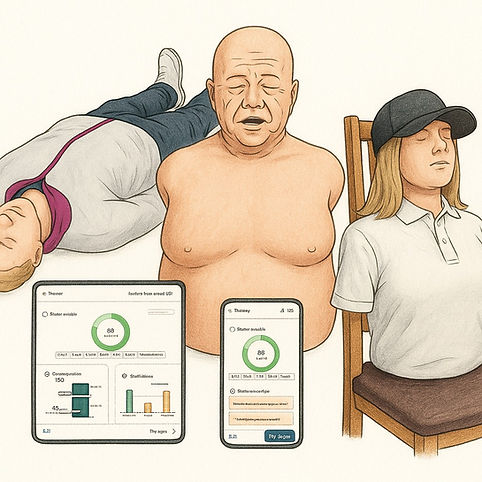
The majority of our CPR training uses Adult, Child, and Infant Laerdal QCPR manikins. These industry leading manikins provide real time feedback through an app or display, allowing you to see exactly how well you are performing while you practise.
This feedback includes:
-
Compression depth
-
Compression rate
-
Chest recoil
-
Hands off time
Seeing this information in real time helps learners understand what good quality CPR actually feels like. It also allows our trainers to coach accurately, based on evidence rather than guesswork. Confidence is built quickly, and improvements are clear and measurable.
Why manikins with breasts matter
One of the most important conversations in modern CPR training is also one of the most uncomfortable. That is exactly why it cannot be ignored.
Research has found that people with breasts experiencing cardiac arrest in public can be less likely to receive bystander CPR than those without.
The precise size of this disparity varies between studies and settings, but researchers have identified concerns about inappropriate touching, accusations of sexual assault and causing injury as possible barriers to intervention.
This is not something CPR training should avoid. It represents hesitation, uncertainty and fear: fear of doing the wrong thing, fear of incorrect hand placement, fear of touching someone’s chest and fear of judgement.
And hesitation costs lives.
For many years, CPR training relied almost entirely on flat chested manikins. While this taught basic technique, it did not reflect the reality of the people first aiders may need to help.

If learners only ever practise CPR on flat chested manikins, uncertainty should not come as a surprise when faced with a real person whose body looks different.
We believe avoiding this issue does not protect learners. It limits them.
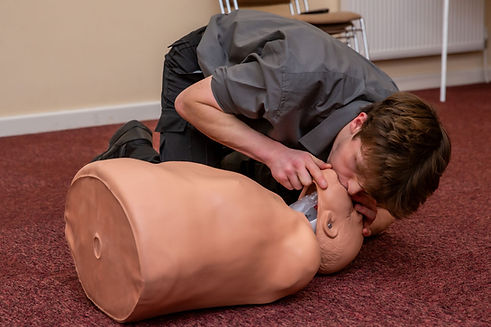
That is why DTMK Training Services actively uses manikins with breasts, including 'Practi Man' models, across our courses. This is a deliberate and ethical training choice.
Practising CPR on manikins with breasts allows learners to:
-
Learn correct hand placement without hesitation
-
Build confidence touching the chest appropriately
-
Remove anxiety before it becomes a barrier to action
-
Understand that life saving care always comes before embarrassment
When this becomes normal in training, it becomes normal in real life. That is how barriers are removed and lives are saved.

Training that reflects real people
Our commitment to realism does not stop there.
You may also meet Fred during your course.
Fred is designed to represent an obese older adult. CPR can feel very different on different body types, and this is something first aiders need to experience in training, not for the first time in an emergency.
Training with Fred helps learners understand changes in chest resistance, positioning challenges, and realistic airway considerations. It reinforces the message that effective CPR is possible on all body types, with the right technique and confidence.
Realism that prompts the right conversations
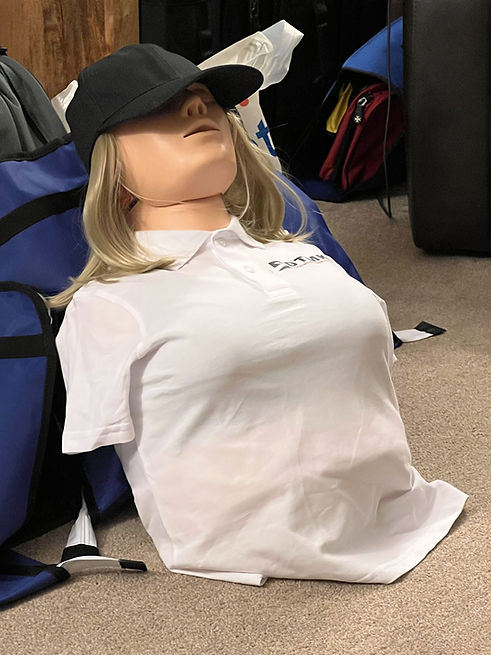
Some of our manikins wear clothing. Some have piercings. Some may have medication patches on them.
These details are intentional.
They allow us to explore real world considerations at the right moment on the course, including:
-
Exposing the chest safely and appropriately
-
AED pad placement around piercings
-
Managing medication patches or medical jewellery
-
Making confident decisions under pressure
Our equipment is designed to provoke discussion, not catch people out. Questions are encouraged, misconceptions are addressed, and confidence is built in a supportive environment.

Training for reality, not just assessment
At DTMK Training Services, our aim is not simply to help you complete a course. It is to ensure that if something does happen, you feel ready to act.
By using a wide range of high quality, realistic manikins, including those with breasts, older adult features, and different body types, we prepare first aiders for the realities they may face.
Because real emergencies do not come with perfect conditions. And good training should never pretend they do.
If you would like to know more about how our courses are delivered or why we train the way we do, please get in touch. We are always happy to talk.