

First Aid at Work Course
Qualsafe Level 3 Award in First Aid at Work (RQF)
Complete this regulated three-day qualification at our Milton Keynes training centre or arrange private First Aid at Work training at your organisation’s own venue.


Ofqual Regulated
3
Year Certification
3
Day Course
Interested in This Course?
There are two ways to complete this three-day First Aid at Work qualification with DTMK.
Attend at Our Milton Keynes Training Centre
Book an individual place on one of our scheduled courses in Milton Keynes. Three course dates are currently available, and places can be booked directly through the course listings below.
Arrange Private Training at Your Venue
Organisations can arrange a private course for a group of employees at their own workplace or another suitable venue. Contact DTMK to discuss your location, learner numbers and preferred dates.


Upcoming Sessions - Book Now
First Aid at Work in Milton Keynes

Regulated three-day Qualsafe qualification with catastrophic bleeding training.
235 British poundsLoading availability...
Loading availability...
Regulated three-day Qualsafe qualification with catastrophic bleeding training.
235 British poundsLoading availability...
Loading availability...
Regulated three-day Qualsafe qualification with catastrophic bleeding training.
235 British poundsLoading availability...
Loading availability...
What Is the First Aid at Work Qualification?
The Qualsafe Level 3 Award in First Aid at Work (RQF) is a regulated qualification for people who may need to respond to a broad range of injuries and medical emergencies in the workplace.
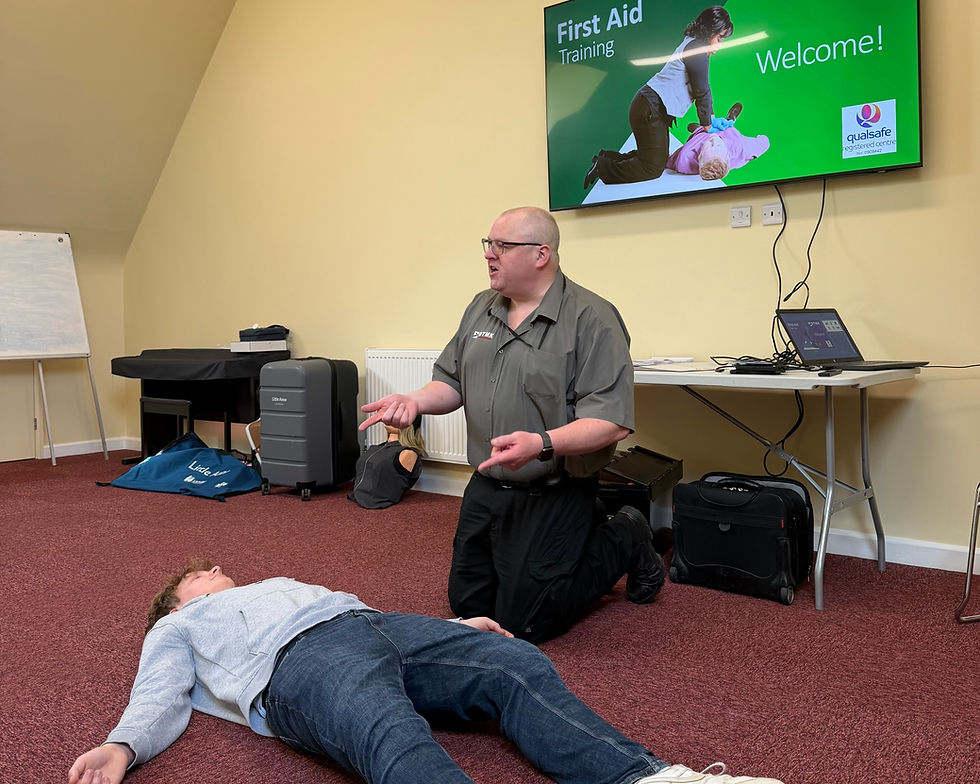
Training is delivered face to face over three days and includes at least 18 hours of guided learning, excluding breaks. Learners develop their knowledge through trainer-led teaching, demonstrations, practical exercises and realistic first aid scenarios.
The qualification contains two mandatory units covering emergency first aid and the recognition and management of workplace illness and injury. Practical assessments are completed throughout the course, together with two multiple-choice question papers.
Learners who successfully complete all required training and assessments receive a regulated First Aid at Work certificate valid for three years.
Not sure whether your workplace requires First Aid at Work or Emergency First Aid at Work? Read our guide:
FIRST AID AT WORK OR EMERGENCY FIRST AID AT WORK: WHICH COURSE DO YOU NEED?
How the Three-Day First Aid at Work Course Works
The qualification contains at least 18 hours of face-to-face training and assessment, delivered across three classroom days. Breaks are additional to these training hours.
The course is structured progressively:
-
Day one develops essential emergency first aid skills, including incident assessment, CPR, AED use, choking, unconscious casualties, bleeding and shock
-
Day two introduces a wider range of workplace illnesses and injuries, including asthma, anaphylaxis, heart attack, stroke, burns, eye injuries and poisoning
-
Day three covers fractures, head and spinal injuries, epilepsy, diabetes and the secondary survey, while revisiting essential practical skills
Trainer demonstrations are followed by guided practice, discussion and realistic first aid scenarios. Learners have opportunities to develop each skill before completing the relevant practical assessment.
Seven practical assessments take place throughout the course. Learners also complete one multiple-choice question paper for each of the qualification’s two mandatory units.
All required training and assessment is completed face to face. Learners must attend all three days and successfully complete both units to achieve the qualification.
What Does the First Aid at Work Course Cover?
The course develops the knowledge and practical skills needed to respond to a broad range of workplace first aid situations.
Emergency First Aid in the Workplace
-
Roles and responsibilities of a workplace first aider
-
Infection prevention, consent and incident reporting
-
Assessing an incident and conducting a primary survey
-
Summoning appropriate assistance
-
Managing an unresponsive casualty
-
The recovery position and seizure management
-
Adult CPR and safe use of an AED
-
Recognising and treating choking
-
External bleeding and hypovolaemic shock
-
Minor injuries, including cuts, grazes, bruises, splinters, nosebleeds and minor burns
Recognition and Management of Illness and Injury
-
The respiratory and circulatory systems
-
Hypoxia and chest injuries
-
Asthma and hyperventilation
-
Wounds, bleeding and different types of shock
-
Anaphylaxis
-
Heart attack and angina
-
Stroke
-
Burns and scalds
-
Poisoning
-
Eye injuries
-
Fractures, dislocations, sprains and strains
-
Head and spinal injuries
-
Epilepsy and diabetes
-
Conducting a secondary survey
The three-day format provides time for learners to build their knowledge, practise unfamiliar procedures and demonstrate the required skills through practical assessment.
Catastrophic Bleeding Training Included
DTMK includes the Qualsafe catastrophic bleeding module as a standard part of this First Aid at Work course.
The additional practical training covers:
-
Recognising life-threatening catastrophic bleeding
-
Wound packing
-
Using an improvised tourniquet
-
Applying a manufactured tourniquet
-
Practical assessment of catastrophic-bleeding management
Learners who successfully complete the additional training and practical assessment receive wording on their Qualsafe certificate acknowledging these skills.
Approximately 30 minutes is added to the overall course duration so that the module can be taught, practised and assessed properly.
For scheduled courses, this additional time will be incorporated into the published course timetable.
Organisations arranging private training should confirm the complete daily timings with DTMK before making staff-cover or venue arrangements.


Who Is This Qualification For?
This qualification is intended for people who have a specific responsibility at work, or through voluntary and community activities, to provide first aid in a range of situations.
It may be appropriate for designated workplace first aiders in environments where the organisation’s first aid needs assessment identifies that broader training is required. This can include workplaces with higher levels of risk, larger workforces, more complex activities or emergency arrangements requiring the wider First Aid at Work syllabus.
The qualification may be suitable for employees working in areas such as:
-
Construction and engineering
-
Manufacturing and warehousing
-
Education and larger childcare settings
-
Hospitality, leisure and events
-
Offices and organisations with larger workforces
-
Voluntary and community organisations
The employer remains responsible for determining the appropriate number and level of trained first aiders through its first aid needs assessment: USE THE FIRST AID REQUIREMENTS CALCULATOR
Entry Requirements
Learners must be at least 14 years old on the first day of training and must be able to perform practical first aid activities at floor level.
There are no other formal entry requirements. However, Qualsafe recommends that learners have a minimum of Level 1 literacy and numeracy, or an equivalent standard.
Because the course is practical, learners should wear suitable clothing and footwear, such as trousers and flat shoes. Learners should be prepared to take part in repeated practical activities throughout all three days.
Anyone booking a scheduled course should tell DTMK about any medical condition, injury or accessibility requirement that may affect their participation before attending.
Accessibility and Reasonable Adjustments
DTMK aims to make training accessible while maintaining the assessment standards required for this regulated qualification.
Please tell us about any disability, medical condition, learning need or other accessibility requirement before booking. This allows us to discuss suitable support and arrange permitted reasonable adjustments with sufficient notice.
Learners must still demonstrate all required practical first aid skills safely and effectively. These include performing CPR at floor level, placing a casualty into the recovery position and completing the other practical assessments.
Support may be available for learners who experience difficulty reading or completing the written multiple-choice papers. Where permitted, the papers may be administered verbally in accordance with the Qualsafe reasonable-adjustment requirements.
Reasonable adjustments cannot remove or alter an essential assessment criterion, but we will work with learners and organisations to identify appropriate support wherever possible.
Key Qualification Information
Qualification title: Qualsafe Level 3 Award in First Aid at Work (RQF)
Qualification number: 603/2384/X
Operational start date: 1 October 2017
Qualification level: Level 3
Guided Learning Hours (GLH): 18 hours across a minimum of three days
DTMK course timing: Approximately 30 additional minutes for the included catastrophic bleeding module
Total Qualification Time (TQT): 22 hours
Credit value: 2
Number of mandatory units: 2
Theory assessment:
-
One 15-question multiple-choice paper - minimum pass mark 11
-
One 25-question multiple-choice paper - minimum pass mark 18
Practical assessment: Seven required practical assessments completed throughout the course
Additional assessment: Catastrophic bleeding practical assessment
Certificate validity: 3 years
Maximum qualification period: Learners must successfully complete all assessments, including any referrals, within 10 weeks
Arrange First Aid at Work Training at Your Venue
DTMK can deliver this three-day qualification privately at your workplace or another suitable venue.
Your venue will need:
-
Sufficient clear floor space for practical first aid activities and assessments
-
A safe, clean and comfortable training environment
-
Suitable seating and writing surfaces for every learner
-
Adequate lighting, heating and ventilation
-
Access to toilets and welfare facilities
-
Minimal noise and disruption throughout all three training days
-
Appropriate space for learners to complete the multiple-choice papers under assessment conditions
DTMK will provide the required first aid training and assessment equipment. We will discuss the venue, course dates, learner numbers and accessibility requirements before confirming the booking.
The course includes at least 18 hours of guided learning across three days, excluding breaks. Approximately 30 additional minutes is incorporated for the catastrophic bleeding module and its practical assessment.
Organisations should confirm the complete daily timings with DTMK before arranging staff cover or finalising their venue.