
Emergency First Aid at Work or First Aid at Work: Which Course Do You Need?

Updated: Aug 31
Choosing between Emergency First Aid at Work and First Aid at Work is not simply a choice between a one-day and a three-day course. Both are regulated workplace first aid qualifications, but they prepare learners for different levels of responsibility and different ranges of illness and injury.
Emergency First Aid at Work concentrates on the immediate priorities that can preserve life and prevent a casualty’s condition from becoming worse. First Aid at Work includes those same essential skills, then develops them further so that learners can respond to a considerably broader range of medical emergencies and injuries.
The right qualification depends on your first aid needs assessment. It should reflect the hazards within your workplace, the number and needs of the people present, your working arrangements and the time it could take for emergency help to arrive.
At DTMK Training Services, catastrophic-bleeding training is included as standard on every Emergency First Aid at Work and First Aid at Work course. Qualsafe identifies this as an additional component, but we believe recognising and controlling life-threatening bleeding is too important to reserve for selected learners. We therefore extend each course by 30 minutes to teach and assess these additional skills properly.


The Short Answer
The Qualsafe Level 3 Award in Emergency First Aid at Work (RQF), usually shortened to EFAW, prepares someone to act as an emergency first aider. It covers the essential response to incidents such as cardiac arrest, choking, an unresponsive casualty, seizures, shock and external bleeding, together with specified minor injuries.
The Qualsafe Level 3 Award in First Aid at Work (RQF), usually shortened to FAW, includes the full EFAW unit and adds a second unit covering a much wider range of illnesses and injuries. These include anaphylaxis, asthma, heart attack, stroke, diabetes, fractures, burns, poisoning and head, spinal, chest and eye injuries.
Neither qualification is automatically right or wrong for a particular workplace. A small organisation can still require FAW-trained first aiders if its activities create significant hazards. A larger workplace may need a combination of FAW and EFAW-trained staff to provide suitable coverage across different areas, shifts or activities.
The decision begins with the workplace, not the course timetable.
What Both Qualifications Have in Common
Both courses are regulated Level 3 qualifications awarded by Qualsafe Awards. Their learning outcomes are based on the Health and Safety Executive’s standards for workplace first aid training and current national resuscitation recommendations.
Both qualifications prepare learners to assess an incident, protect themselves and other people, summon appropriate help and provide immediate care. Learners practise responding to an unresponsive casualty, performing CPR, using an automated external defibrillator, dealing with choking and controlling external bleeding.
They also explore the responsibilities of a first aider, including consent, infection control, incident reporting, safe use of equipment and an effective handover to the emergency services.
These shared foundations matter. A person completing EFAW is not receiving an incomplete version of first aid training. They are completing a focused qualification designed for emergency first aid situations. FAW begins with the same foundation and then extends the learner’s knowledge, practical ability and decision-making.
Both qualifications are valid for three years. The Health and Safety Executive strongly recommends annual refresher training to help first aiders maintain their skills and confidence between full qualifications.
What Is Covered on Emergency First Aid at Work?
Emergency First Aid at Work focuses on the early stages of an incident, when calm decisions and prompt action can make an enormous difference.
Learners explore how to assess the scene and casualty safely, conduct a primary survey and call for appropriate help. They practise CPR and the safe use of an AED, including responding when a casualty is unresponsive and not breathing normally.
The course also covers an unresponsive casualty who is breathing normally, the recovery position, seizures, choking, shock and external bleeding. Minor cuts, grazes, bruises, splinters and minor burns or scalds are included within the qualification.
Assessment takes place throughout the course. Learners complete practical assessments involving CPR and AED use, choking, an unresponsive casualty, and wounds, bleeding and shock. They must also complete a 15-question multiple-choice paper and achieve the required pass mark.
Qualsafe normally specifies six guided learning hours for EFAW. At DTMK, the programme is extended by an additional 30 minutes because catastrophic-bleeding training is included as standard.
This produces an intensive practical day, but its scope remains clearly defined. It prepares someone to deal with emergency first aid situations. It does not cover the broader range of injuries and medical conditions included in FAW.
What Does First Aid at Work Add?
First Aid at Work includes the complete Emergency First Aid in the Workplace unit. The first part of the course therefore develops the same essential skills in incident assessment, CPR, AED use, choking, casualty management, bleeding, shock and minor injuries.
The additional training moves beyond the initial emergency response. Learners explore how different illnesses and injuries may present, how a casualty’s condition can change and what appropriate first aid may involve while professional help is arranged.
The extended content includes:
Anaphylaxis and the use of an adrenaline auto-injector
Asthma and hyperventilation
Heart attack, angina and stroke
Epilepsy and diabetes
Fractures, dislocations, sprains and strains
Head and spinal injuries
Chest and eye injuries
Burns and scalds
Poisoning and exposure to harmful substances
A more detailed secondary survey and casualty examination
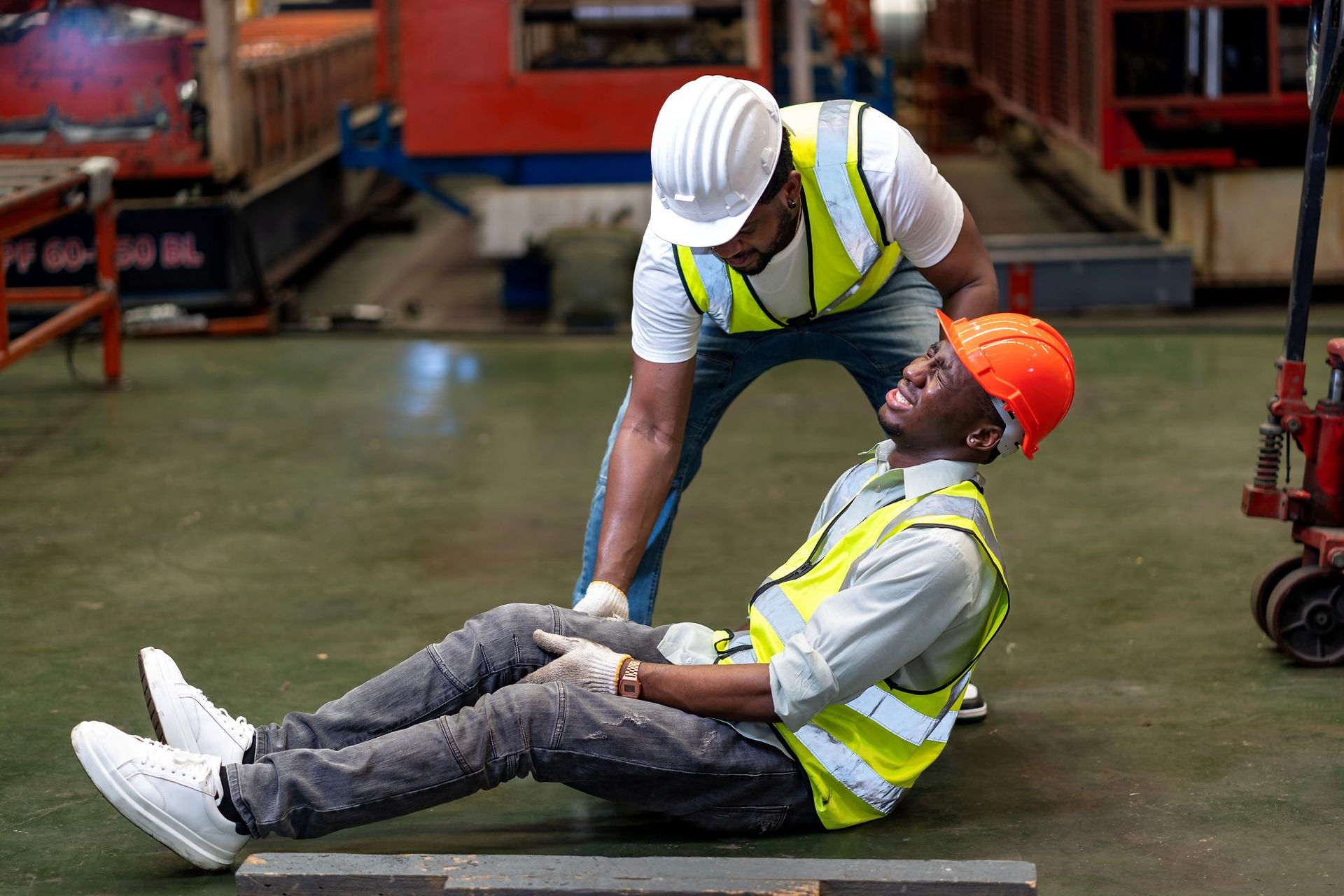


FAW learners practise supporting limb injuries, responding to suspected spinal trauma and conducting a structured secondary survey. They develop a wider understanding of respiratory and circulatory emergencies and learn to recognise conditions that may not initially look as dramatic as a cardiac arrest or severe bleed but still require urgent action.
The formal qualification contains 18 guided learning hours across a minimum of three days. At DTMK, the course is extended by 30 minutes overall to accommodate our standard catastrophic-bleeding session.
Assessment is correspondingly broader. Learners complete seven practical assessments and two multiple-choice papers, one containing 15 questions and the other containing 25 questions.
This additional time is not simply used to deliver more theory. It gives learners repeated opportunities to practise, discuss realistic situations and demonstrate a wider range of first aid skills.
Emergency First Aid at Work and First Aid at Work Compared
Course feature | Emergency First Aid at Work | First Aid at Work |
Intended role | Emergency first aider | Workplace first aider |
Standard guided learning | 6 hours | 18 hours over at least 3 days |
DTMK delivery | Standard course extended by 30 minutes | Standard course extended by 30 minutes overall |
Mandatory qualification units | 1 | 2 |
CPR and AED | Included | Included |
Unresponsive casualty | Included | Included |
Choking | Included | Included |
External bleeding and shock | Included | Included |
Specified minor injuries | Included | Included |
Catastrophic bleeding at DTMK | Included as standard | Included as standard |
Anaphylaxis and asthma | Not within the standard EFAW syllabus | Included |
Heart attack and stroke | Not within the standard EFAW syllabus | Included |
Fractures and dislocations | Not within the standard EFAW syllabus | Included |
Head, spinal and chest injuries | Not within the standard EFAW syllabus | Included |
Burns, poisoning and eye injuries | Limited minor burns only within EFAW | Broader coverage included |
Theory assessments | One 15-question paper | One 15-question and one 25-question paper |
Mandatory practical assessments | Four, plus DTMK catastrophic-bleeding assessment | Seven, plus DTMK catastrophic-bleeding assessment |
Certificate validity | 3 years | 3 years |
The table helps illustrate the difference, but course choice should never be made by counting ticks alone. The important question is whether the selected qualification prepares your first aiders for the situations your assessment identifies.
Why DTMK Includes Catastrophic Bleeding as Standard
Life-threatening bleeding can follow machinery incidents, vehicle collisions, falls, broken glass, sharp tools or deliberate violence. It is uncommon in many workplaces, but when it occurs there may be very little time available to control it.
Catastrophic bleeding is identified by Qualsafe as an additional component within both qualifications. DTMK has chosen to include it as standard rather than offer it only to organisations that anticipate a particular risk.
During the additional 30-minute session, learners consider how to recognise life-threatening bleeding and how its management fits within the primary survey. They practise wound packing and the application of manufactured and improvised tourniquets, followed by the required practical assessment.
This is taught carefully and proportionately. The aim is not to make every incident appear dramatic. It is to help learners distinguish ordinary external bleeding from a situation in which rapid, decisive bleeding control may be essential.
The additional training is recorded appropriately as part of the learner’s achievement.


Your First Aid Needs Assessment Comes First
Employers must provide adequate and appropriate first aid equipment, facilities and people so that employees can receive immediate help if they are injured or become ill at work. What counts as adequate and appropriate depends on the circumstances of the individual workplace.
The Health and Safety Executive advises employers to assess their first aid needs rather than rely on a universal rule.
A meaningful assessment should consider the nature of the work, foreseeable hazards, previous incidents, workforce size and distribution, shift patterns, lone working and staff absences. It should also take account of employees who travel, work remotely or move between multiple sites.
The needs of people using the premises may also be relevant. A workplace regularly visited by members of the public may face different demands from a small office with no visitors. Existing health conditions, disabilities, language needs and the age profile of the workforce may influence the arrangements required.
Distance from emergency assistance matters too. Two workplaces carrying out similar activities may reach different conclusions if one is close to emergency services while the other operates in an isolated location.
The result may be EFAW, FAW, specialist additional training or a planned combination of qualifications. The assessment should also decide how many trained people are needed to maintain suitable cover during holidays, sickness, shift changes and off-site work.
Which Course Might Suit My Workplace?
EFAW may be proportionate where the needs assessment identifies lower-level hazards and concludes that trained emergency first aiders can provide the required cover. Offices, small shops and some administrative environments may reach this conclusion, although their individual circumstances must still be considered.
FAW may be more appropriate where there are higher workplace hazards, dangerous machinery, chemicals, manual work or a greater likelihood of significant injury. It may also be selected where the workforce is large or dispersed, where medical help may take longer to reach the site, or where first aiders need to respond to a broader range of illnesses.
Healthcare, care, education and childcare settings require particular thought. Their needs cannot be determined from an industry label alone. Employers must consider the people being supported, the activities taking place and any sector-specific duties or training requirements.
Some organisations use FAW-trained staff to provide their principal first aid coverage, supported by additional EFAW-trained colleagues across departments or shifts. This can be effective when it is based on a documented assessment and provides reliable cover whenever people are at work.
Cost and convenience are reasonable practical considerations, but they should be considered after the required provision has been identified. A shorter course is not a saving if it leaves first aiders unprepared for foreseeable situations.
Classroom and Blended Learning Options
FAW can be completed through traditional classroom training or an approved blended-learning format.
DTMK’s blended First Aid at Work course combines approximately six hours of online learning with two classroom days. The online element must be completed before attendance, while practical skills and formal assessments remain within the face-to-face programme.
Blended learning can help organisations reduce the time employees spend away from work at once. However, it is not a shortened qualification and it does not remove the practical component. Learners must still complete the required learning and demonstrate their competence in person.
A blended Emergency First Aid at Work option is also available. This combines advance online learning with classroom-based practical teaching and assessment.
Learners who prefer continuous trainer-led teaching can choose the fully classroom-based format. The resulting regulated qualification is determined by the course completed, not by whether an approved part of the learning took place online.


Real World Examples
A Small Professional Office
An accountancy firm employs ten people in a small office close to the centre of Milton Keynes. Its activities involve computers, office furniture and routine kitchen facilities. There are no unusual workplace hazards, and emergency services can reach the building easily.
Its assessment might conclude that EFAW-trained staff provide proportionate cover, provided enough people are trained to cover absence, holidays and hybrid working.
That conclusion would not arise simply because the organisation is an office. It would follow from examining its actual activities, people and arrangements.
A Warehouse and Distribution Business
A warehouse employs staff across several shifts. Workers use handling equipment, move heavy goods and operate in different areas of a large site. Some employees also drive delivery vehicles away from the premises.
The potential for falls, crush injuries, significant bleeding and musculoskeletal injury may make FAW-trained first aiders more appropriate. The organisation might supplement them with additional EFAW-trained staff to maintain coverage across the building and different shifts.
Its assessment would also need to consider lone working, drivers, communication systems and the accessibility of first aid equipment.
A Care Organisation
A care provider supports people with complex health needs. Staff may encounter falls, fractures, seizures, diabetes, stroke, breathing difficulties or sudden cardiac arrest.
The wider illness and injury content within FAW may be valuable, but workplace first aid training is only one part of the organisation’s overall provision. The employer must also consider clinical responsibilities, residents’ care plans, medication arrangements and any additional training required for the setting.
A generic industry label cannot replace that detailed assessment.
First Aid Training in Milton Keynes and the Surrounding Counties
DTMK Training Services provides regulated workplace first aid training from our dedicated venue in Bletchley, Milton Keynes. We also deliver private courses for organisations across Buckinghamshire, Bedfordshire, Northamptonshire, Oxfordshire and the surrounding areas.
Centre-based courses allow individual learners and smaller organisations to access scheduled training without arranging a full private group. Private delivery can take place at an employer’s premises and allows examples and practical discussions to reflect the organisation’s working environment.
Our courses use practical equipment, realistic scenarios and a range of training manikins. Learners are supported to understand why an action is required, practise it properly and develop the confidence to use their skills beyond the assessment.
We are an approved Qualsafe Awards centre. Courses are delivered and assessed in accordance with the awarding organisation’s requirements, while our additional catastrophic-bleeding content ensures every EFAW and FAW learner receives this important preparation.
Frequently Asked Questions
Is Emergency First Aid at Work a Lower Qualification Than First Aid at Work?
Both are regulated Level 3 qualifications. The difference lies in their purpose, content and breadth rather than one being described simply as a lower level.
EFAW prepares learners to respond to emergency first aid situations. FAW contains the same emergency unit and adds a second unit covering a wider range of specific illnesses and injuries.
Your needs assessment determines which breadth of training is appropriate.
Does Every Workplace Need a First Aid at Work Qualified Person?
Not necessarily. Employers must provide adequate and appropriate first aid arrangements, but the qualification required depends on their assessment.
Some lower-hazard workplaces may conclude that EFAW-trained first aiders provide suitable coverage. Other organisations will require FAW-trained staff, specialist training or a mixture of qualifications.
Can Someone With EFAW Upgrade to FAW Later?
A learner can subsequently complete FAW, but this should be discussed with the training provider. The full FAW qualification contains two mandatory units and requires all relevant learning and assessments to be completed.
It is better to identify the required qualification before training begins whenever possible, particularly when an employer’s assessment already indicates that the broader FAW coverage is necessary.
How Long Do EFAW and FAW Certificates Last?
Both qualifications are valid for three years. Learners should complete the appropriate requalification before their certificate expires if they need to remain qualified.
FAW holders may be eligible for a shortened requalification programme when they provide an acceptable current or recently expired certificate and meet the applicable conditions. Leaving requalification too late can result in the full course being required again.
Does Annual Refresher Training Renew the Three-Year Certificate?
No. Annual refresher training helps first aiders practise core skills and maintain confidence, but it does not replace the full requalification required before the main certificate expires.
Employers should therefore monitor both annual refresher opportunities and formal certificate expiry dates.
Is Catastrophic Bleeding Included on DTMK Courses?
Yes. DTMK includes catastrophic-bleeding training as standard on every EFAW and FAW course.
The programme is extended by 30 minutes to cover recognition of life-threatening bleeding, wound packing and manufactured and improvised tourniquets, together with practical assessment. It is not treated as a chargeable extra that learners must request separately.
Summary
Emergency First Aid at Work and First Aid at Work share the same essential emergency foundation. Both develop practical skills in incident assessment, CPR, AED use, choking, unresponsive-casualty management, bleeding and shock.
EFAW focuses on the immediate response to emergency first aid situations. FAW includes that complete foundation and develops the learner’s ability to respond to a much wider range of injuries and medical conditions.
The correct choice cannot be decided solely by company size, industry or course price. It must follow a first aid needs assessment that reflects the real circumstances of the workplace.
At DTMK, both programmes include an additional 30 minutes of catastrophic-bleeding training as standard. This gives every learner an opportunity to recognise life-threatening bleeding and practise the techniques that may be required to control it.
Choose the Right Workplace First Aid Course
If your assessment has already identified the required qualification, you can explore DTMK’s workplace first aid courses, including our classroom Emergency First Aid at Work course and classroom First Aid at Work course.
You can also view forthcoming course dates and book online.
If you are arranging training for a team, request training for your organisation. We can discuss your working environment, delivery options and the most appropriate way to provide reliable first aid coverage.
If you are still uncertain which qualification your assessment indicates, speak to DTMK before booking. We will help you understand the practical differences without pressuring you towards a course that does not reflect your organisation’s needs.
Call 01908 112111 or email enquiries@dtmk.co.uk.


Comments