
First Aid at Work Course in Milton Keynes: What to Expect

Updated: Aug 28
The First Aid at Work course is a three-day qualification designed for people who may need to respond to a wide range of injuries and illnesses in the workplace. It goes beyond the emergency essentials by helping learners recognise problems, make sensible decisions, give appropriate initial care and obtain further help when it is needed.
For employers, choosing the right course matters because workplace first aid arrangements should reflect the risks identified in their first aid needs assessment. For learners, knowing what to expect can remove much of the uncertainty. You don't need to arrive with medical knowledge, but you should be prepared to take part in practical activities, discuss realistic situations and complete both practical and written assessments.
This guide explains who the Qualsafe Level 3 Award in First Aid at Work (RQF) is intended for, what is covered across the three days and how learners are assessed. It also explains the difference between First Aid at Work and Emergency First Aid at Work, so employers can make a more informed choice.


What Is the First Aid at Work Qualification?
The Qualsafe Level 3 Award in First Aid at Work (RQF) is a regulated workplace first aid qualification. It is often shortened to FAW. The course combines the emergency skills included in Emergency First Aid at Work with a broader examination of workplace injuries and medical conditions.
That wider scope is important. A workplace incident isn't always a straightforward cut or faint. A first aider might need to recognise a developing stroke, respond to a serious burn, support somebody with a suspected fracture or gather useful information while waiting for an ambulance. The FAW course develops a structured approach to these situations without expecting the learner to become a healthcare professional.
The qualification contains two mandatory units. The first concerns emergency first aid in the workplace. The second focuses on recognising and managing illness and injury. The specification sets 18 guided learning hours, delivered over a minimum of three days, and 22 hours of total qualification time when directed preparation and study are included. Practical work and assessment are built into the programme rather than left until one final test.
Who Is the Course Designed For?
First Aid at Work is designed for people selected to act as workplace first aiders, particularly where an employer's needs assessment identifies more substantial risks. This may include organisations using machinery, tools, vehicles, chemicals or manual handling, as well as larger or more complex workplaces where a wider range of incidents could occur.
Job title alone doesn't determine the correct course. A small office and a busy warehouse can have very different needs, but staff numbers are not the only consideration. Employers should also consider hazards, accident history, shift patterns, lone workers, the distance from emergency medical help, members of the public and any workers with known health needs. The result may show that FAW training is appropriate even in a workplace that doesn't immediately appear hazardous.
Learners don't need previous first aid experience. The awarding organisation sets a minimum age of 14 on the first day of training, and learners must be able to perform practical tasks at floor level. It strongly recommends at least Level 1 literacy and numeracy, although these are not formal entry qualifications. Anyone with an injury, health condition, disability or concern about assessment should speak privately with the training provider before the course. Reasonable adjustments may be possible, although the qualification's practical standards must still be demonstrated. Comfortable, suitable clothing and flat footwear are sensible because of the physical practice involved.
What the Three-Day Course Covers
The first day establishes the foundations of safe emergency care. Learners explore the role and responsibilities of a first aider, including consent, infection control and incident reporting. They learn how to assess the scene, carry out an initial casualty assessment and summon suitable assistance. This encourages a calm order of priorities rather than rushing towards an injured person without first considering danger.
Cardiopulmonary resuscitation and the safe use of an automated external defibrillator form a substantial practical part of the day. Learners also practise responding to choking and managing an unresponsive casualty who is breathing normally. Seizures are considered within this part of the programme, helping learners understand what they may observe and how the casualty should be protected.
External bleeding and hypovolaemic shock receive detailed attention. Learners consider how serious bleeding is recognised and managed, then demonstrate relevant practical skills. The Qualsafe programme identifies life-threatening catastrophic bleeding as an optional additional component, covering wound packing and the application of improvised and manufactured tourniquets. DTMK Training Services includes this component as standard on every Emergency First Aid at Work and First Aid at Work course it delivers. Learners attending a DTMK course can therefore expect catastrophic bleeding to be included rather than offered only as an optional extra.
The first day also addresses common minor injuries, including small cuts, grazes, bruises, splinters, minor burns, scalds and nosebleeds. This may sound less dramatic than CPR, but minor incidents are often the situations a workplace first aider encounters most frequently. Treating them sensibly, maintaining hygiene and recognising when an apparently minor problem needs further attention are all valuable workplace skills.
On the second day, the course broadens into illnesses and injuries that require careful recognition. Learners consider the respiratory and circulatory systems in enough context to understand what can go wrong. Topics include hypoxia, chest injuries, asthma, hyperventilation, different forms of shock and fainting. The purpose isn't to deliver an anatomy lecture. It is to help learners connect visible signs, the circumstances of an incident and the appropriate first aid response.
Wounds and bleeding are developed further, alongside eye injuries, burns and scalds, and exposure to poisonous substances. Anaphylaxis is covered through explanation and practical assessment. Learners also examine heart attacks, angina and strokes, including how presentation can vary and why prompt recognition matters.
The third day returns briefly to CPR and AED practice before concentrating on musculoskeletal and neurological concerns. Fractures, dislocations, sprains and strains are discussed, with practical work involving support and elevated slings. Head and spinal injuries are considered in detail, including recognition, airway considerations and ways to minimise unnecessary movement while waiting for professional help.
The programme then covers epilepsy and hypoglycaemic emergencies associated with diabetes. Learners revisit the management of an unresponsive breathing casualty before moving to a secondary survey. This involves gathering a casualty history and carrying out a methodical head-to-toe check to identify injuries or illness that may not have been obvious during the initial assessment.
It is a broad programme, but the subjects are connected by a consistent principle: identify immediate danger, deal with the most serious problem first, seek suitable help and continue monitoring the casualty. Learners aren't expected to memorise a collection of disconnected facts. Good training helps them develop an approach they can apply when a real incident doesn't look exactly like a classroom example.

What Practical Training Feels Like
Many people feel apprehensive about practical first aid training, especially if they haven't attended a course before. They may worry about being watched, making a mistake or remembering everything immediately. A well-run course builds skills progressively. The trainer demonstrates techniques, explains the reasoning and gives learners repeated opportunities to practise before formal decisions are recorded.
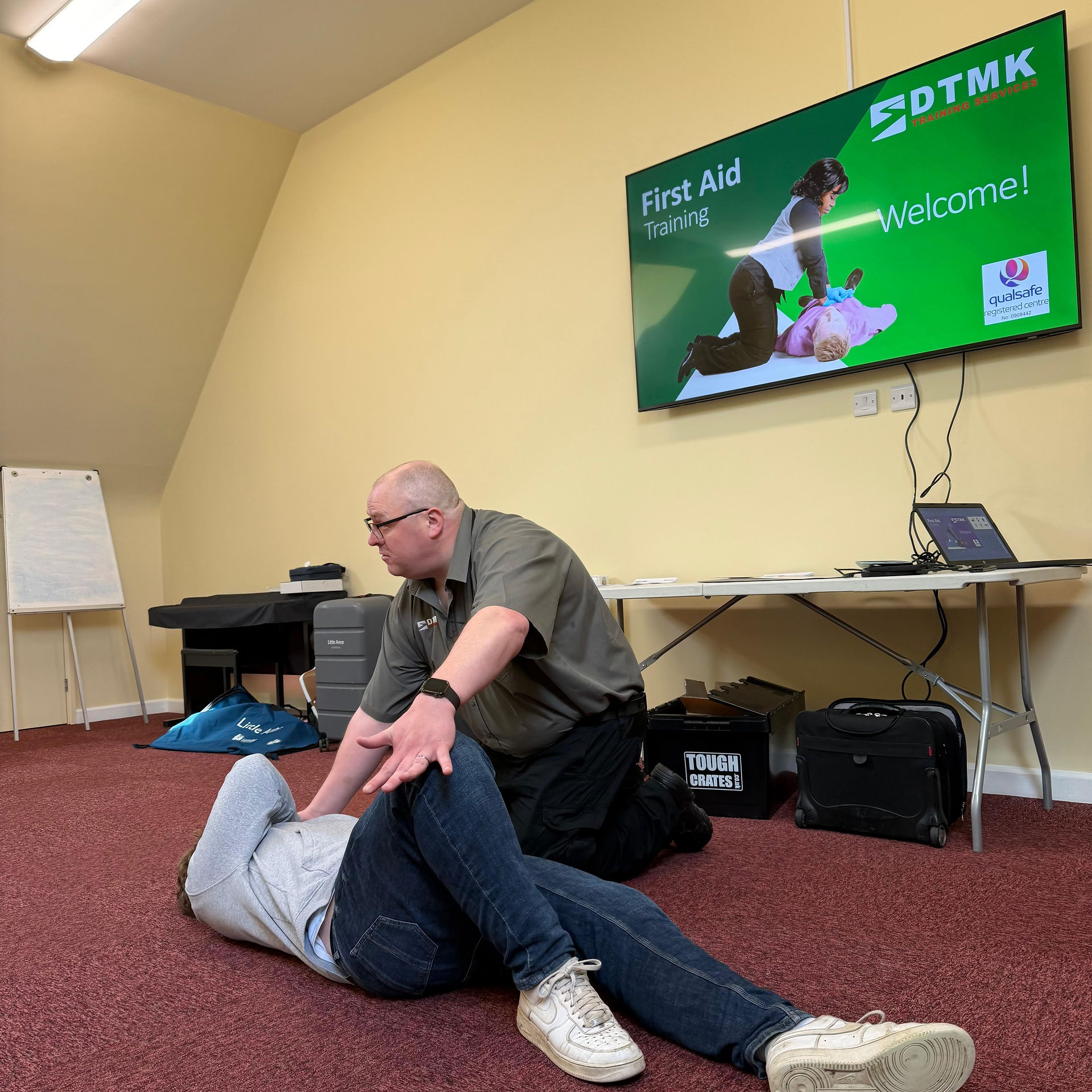
CPR is practised on training manikins, not on another learner. AED training uses demonstration equipment so learners can become familiar with pad positioning, spoken prompts and safety checks without using a live defibrillator. Other activities involve working with classmates, such as practising the recovery position, applying slings and conducting a secondary survey. Trainers should manage these sessions respectfully and explain what will happen before physical contact takes place.
Practical work matters because recognising a phrase in a book isn't the same as responding under pressure. A learner might understand that a casualty needs to be placed in the recovery position but still need practice to do it safely and confidently. Repetition allows the sequence to become more familiar, while trainer feedback corrects misunderstandings before they become habits.
The course can also involve emotionally difficult subjects. Cardiac arrest, severe bleeding and serious illness may remind somebody of a personal experience. Learners should feel able to tell the trainer privately if they need support. A calm learning environment doesn't remove the seriousness of first aid, but it helps people engage with it constructively.


How Learners Are Assessed
Assessment takes place throughout the course. The qualification requires seven practical assessments, covering CPR and safe AED use, a choking casualty, an unresponsive casualty, wounds, bleeding and shock, anaphylaxis, fractures, and the secondary survey. Some related skills are grouped within these assessments, so learners should expect their trainer to observe not just an isolated action but the safety and logic of their overall response.
There are also two multiple-choice question papers, one for each unit. The first contains 15 questions and requires at least 11 correct answers. The second contains 25 questions and requires at least 18 correct answers. This written element checks knowledge that cannot always be demonstrated fully in a short scenario, while practical assessment confirms that learners can apply essential skills.
The word assessment can make the course sound intimidating, but it shouldn't be a surprise examination. Learners practise during the sessions, receive guidance and have opportunities to ask questions. If somebody struggles with reading or writing, they should raise this confidentially. The lesson plan makes clear that verbal assessment and other reasonable adjustments may be available when properly arranged.
A common mistake is to approach the course as a memory test and concentrate only on passing the paper. First aid depends on priorities, observation and judgement. Understanding why an action is appropriate makes knowledge easier to recall and helps a learner adapt when a real emergency differs from the examples used in class.
First Aid at Work or Emergency First Aid at Work?
Emergency First Aid at Work is normally a one-day course covering the essential response to workplace emergencies. First Aid at Work contains that emergency foundation but extends training across three days to include a wider range of injuries, illnesses and assessment skills.
The longer course is not automatically required by every employer, and the shorter course shouldn't be chosen simply because it is quicker. The decision should follow a suitable first aid needs assessment. A low-risk workplace may decide that Emergency First Aid at Work provides an appropriate level of trained cover. A higher-risk environment, a larger workforce or an organisation with particular hazards may need employees who hold the fuller FAW qualification.
Employers should also think beyond a single certificate. Holiday, sickness, shift work and employees working across different sites can all affect whether trained cover is actually available. A well-considered arrangement may involve several first aiders with different levels of training, supported by suitable equipment, clear procedures and regular review.
Real World Examples
Imagine a worker in a Milton Keynes warehouse who falls awkwardly beside a loading area. They are conscious but report neck pain and tingling after striking their head. A trained first aider doesn't simply help them stand up. The course helps the first aider consider the mechanism of injury, keep the casualty as still as circumstances allow, summon appropriate help, monitor them and provide a clear handover when professionals arrive.
In an office, a colleague becomes pale and confused and starts behaving unusually. It would be easy to assume they are stressed or unwell and send them somewhere quiet. FAW training includes hypoglycaemic emergencies, helping the first aider gather information, recognise relevant signs and respond according to the casualty's condition rather than relying on guesswork.
At a workshop, somebody suffers a substantial bleeding injury while using equipment. The first aider must consider danger, protect themselves, assess the casualty, control the bleeding and call for help. The situation may also involve shock and require continued monitoring. Training cannot reproduce every workplace incident, but practical scenarios give learners a framework for acting while other people may be frightened or uncertain.
Finally, consider a customer who develops breathing difficulty and swelling following exposure to an allergen. The FAW course includes recognition of anaphylaxis, its common triggers and its management, supported by practical assessment. That knowledge can help a first aider recognise the urgency and respond promptly while emergency assistance is arranged.
Why This Matters for Workplaces in Milton Keynes
Milton Keynes includes offices, industrial estates, warehouses, shops, hospitality venues, schools, construction sites and organisations that operate vehicles across the city and beyond. These workplaces don't share one risk profile. A city-centre office may focus on staff health conditions and visitor safety, while a logistics or engineering business may also face machinery, movement, manual handling and bleeding risks.
Local employers should therefore avoid treating first aid training as a standard purchase made without context. The right starting point is the organisation's own needs assessment. This should consider what employees actually do, when they work, who visits the premises and how quickly additional help could arrive. Training then becomes part of a practical safety arrangement rather than a certificate stored in a personnel file.
Choosing first aid training in Milton Keynes can also make attendance and renewal easier for local staff. Reduced travel can help employers release people from work and allows learners to train in a setting that feels relevant to the environments they know. For group bookings, discussing genuine workplace hazards with the trainer can make examples more meaningful while the qualification requirements remain consistent.
Frequently Asked Questions
How long does the course take, and how long is the qualification valid?
The initial Qualsafe Level 3 Award in First Aid at Work (RQF) has 18 guided learning hours over a minimum of three days. Its timetable includes teaching, discussion, practical practice and assessment. The qualification is valid for three years. To remain qualified, a learner must requalify before the certificate expires. A current or recently expired acceptable FAW certificate may permit attendance on a 12-hour requalification course, but an expired certificate means the person is no longer considered competent to act as a workplace first aider. Employers should therefore monitor expiry dates rather than leave renewal until the last moment.
Do I need any previous first aid experience?
No previous first aid qualification is required for a standard FAW course. Training begins with the role of the first aider and the safe assessment of an incident before progressing into practical and more detailed subjects. Learners who haven't studied for some time may feel nervous about assessment, but the course is designed to develop knowledge through explanation and practice rather than assume an existing medical background.
Is there a written examination?
There are two multiple-choice theory assessments, one relating to each unit, as well as practical assessments completed during the course. Learners who may need support with reading or writing should discuss this confidentially with the provider in advance. The Qualsafe lesson plan allows for reasonable adjustments, including verbal delivery of an assessment where appropriate and properly documented.
Will I have to perform first aid on other learners?
CPR is performed on a manikin and AED practice uses training equipment. Some other activities involve working with classmates, including recovery position practice, slings and casualty surveys. The trainer should explain each activity, obtain appropriate cooperation and manage the session respectfully. If you have an injury or condition that may affect practical work, tell the provider before the course so possible adjustments can be considered.
How do employers decide whether this is the right course?
An employer should complete a first aid needs assessment rather than choosing solely by business size or course price. The assessment should consider workplace hazards, workforce distribution, working hours, previous incidents, lone working, visitors and access to emergency assistance. This may indicate that FAW is appropriate, that EFAW is sufficient or that a combination of trained people is needed across different roles and shifts.
Does DTMK include catastrophic bleeding and tourniquet training?
Yes. DTMK Training Services includes the catastrophic bleeding component on every Emergency First Aid at Work and First Aid at Work course it delivers. Although Qualsafe identifies this as an optional additional component within its programme, DTMK has chosen to include it as standard. The session covers the recognition of life-threatening bleeding, wound packing and the application of improvised and manufactured tourniquets, with appropriate practical training and assessment.


Summary
The First Aid at Work course is a comprehensive three-day workplace qualification. It begins with safe incident assessment, CPR, AED use, choking, unconscious casualties and bleeding, then develops into a wider consideration of injuries and major illnesses. Practical activities and two theory papers allow learners to demonstrate both knowledge and application.
The course suits workplaces whose first aid needs assessment identifies a need for broader competence than a one-day emergency course provides. Learners don't need medical experience, but they do need to participate, practise and engage with assessment. Knowing this in advance helps both the employer and the learner prepare properly.
First Aid Training in Milton Keynes with DTMK Training Services
DTMK Training Services provides first aid training in Milton Keynes with an emphasis on clear explanation, supportive practice and realistic workplace application. The aim is not simply to move learners through an assessment. It is to help them understand their priorities and leave better prepared to respond when somebody genuinely needs assistance.
Employers can use their first aid needs assessment to discuss whether the three-day First Aid at Work qualification is the suitable choice for their team. Individual learners can view current availability and course information on the DTMK booking page at https://training.dtmk.co.uk/book-online.
**Catastrophic bleeding training is included as standard on DTMK's EFAW and FAW courses, while employers with other workplace-specific requirements are welcome to discuss them before booking.


Comments