
How Does a Defibrillator Work, and Can Anyone Use One?

Updated: Aug 29
An automated external defibrillator, usually called an AED, is designed to help someone in cardiac arrest. It analyses the electrical activity in the heart and only advises or delivers a shock when it detects a rhythm that may respond to defibrillation.
You don’t need to be a doctor, nurse or paramedic to use one. Resuscitation Council UK’s 2025 guidance states clearly that anyone can use an AED and that no previous training is required. The machine provides spoken and visual instructions, checks the heart rhythm itself and decides whether a shock is appropriate.
That simplicity is deliberate. Someone facing a cardiac arrest may be frightened, upset and completely unfamiliar with medical equipment. An AED has to work for that person, not just for a healthcare professional who uses one regularly.
Training still has enormous value because it gives people a chance to practise CPR, become familiar with the equipment and make decisions without the pressure of a real emergency. However, a lack of training should never stop someone from using an available AED when directed to do so during a cardiac arrest.
What Happens During a Cardiac Arrest?
The heart normally contracts in an organised rhythm, moving blood around the body so that oxygen can reach the brain and other vital organs. That rhythm depends on a coordinated electrical system within the heart.
During a cardiac arrest, the person becomes unresponsive and stops breathing normally because the heart is no longer pumping blood effectively. They may not be completely still or silent. Abnormal gasping, occasional noisy breaths or a panting pattern can occur during the early stages of cardiac arrest and shouldn’t be mistaken for normal breathing.
The Resuscitation Council UK 2025 guidance introduced an important change in the sequence followed by members of the public. If you find someone unresponsive, call 999 as soon as possible. If another person is present, ask them to make the call. If you’re alone, make the call yourself before assessing whether the person is breathing normally.
The ambulance service call handler can help you recognise abnormal breathing and provide CPR instructions. Once CPR is underway, they may ask whether an AED or defibrillator is available and direct another bystander to retrieve one.
How Does a Defibrillator Work?
Films and television have given defibrillators a rather dramatic reputation. Someone shouts “clear”, a body leaps from the bed and a flat line magically returns to normal. It makes exciting television, but it creates a misleading picture of what defibrillation actually does.
An AED doesn’t simply jump-start a heart that has stopped in the way jump leads might start a car. It looks for particular abnormal electrical rhythms in which the heart’s electrical activity has become chaotic or dangerously ineffective.
One of these rhythms is ventricular fibrillation. Instead of contracting in an organised way, the heart muscle quivers and fails to pump blood effectively. Another shockable rhythm is pulseless ventricular tachycardia, where the lower chambers of the heart produce electrical activity so rapidly that effective circulation is lost.
A defibrillation shock briefly passes an electrical current through the heart. This interrupts the disorganised electrical activity, giving the heart’s natural electrical system an opportunity to regain control and establish an effective rhythm.
A useful comparison is resetting a frozen electronic device. The shock doesn’t provide a permanent power supply or force the heart to continue beating. It interrupts the electrical disorder so that an organised rhythm may return.
Not every cardiac arrest involves a shockable rhythm. If the AED analyses the heart and doesn’t identify a rhythm that may benefit from a shock, it will announce that no shock is advised. The rescuer should immediately continue CPR and follow the machine’s instructions.
This ability to analyse the rhythm is one of the AED’s most important safety features. The person using it doesn’t have to interpret an electrocardiogram or decide whether a shock is clinically appropriate. The machine makes that decision.
What Should You Do If Someone Is Unresponsive?
Resuscitation Council UK’s 2025 community basic life support sequence places early contact with the ambulance service at the centre of the response.
If someone appears to be unresponsive:
Make sure it is safe to approach.
Check for a response and shout or call for help.
Call 999 as soon as possible. If another person is available, ask them to call while you remain with the casualty.
Assess whether the person is breathing normally while waiting for the call to be answered.
If the person is unresponsive and breathing abnormally, assume cardiac arrest and begin CPR.
Send someone to retrieve an AED if one is available.
Switch on the AED as soon as it arrives and follow its instructions.
Continue CPR and AED use until the ambulance service takes over or the person shows signs of life.
The ambulance service call handler will guide you if you’re uncertain. Put the phone on speaker so that you can listen while keeping your hands free.
If you’ve been trained and are willing to provide rescue breaths, alternate 30 chest compressions with two breaths. If you aren’t trained to provide breaths, the call handler can guide you through continuous chest compressions.
What Does the AED Ask You to Do?
Different AED models vary slightly, but they all follow the same essential principles.
Some machines switch on when their case or lid is opened. Others have a clearly marked power button. Once activated, the AED begins giving spoken instructions and may also display diagrams or written prompts.
The electrode pads must be attached to the person’s bare chest in the positions shown on the pads. One normally sits on the upper right side of the chest, while the other is placed on the left side below the armpit. Correct positioning allows the electrical current to pass through the heart.
Resuscitation Council UK’s 2025 guidance also addresses removing a bra during defibrillation. The priority is correct pad placement on bare skin. If the pads can be positioned correctly without removing the bra, it may remain in place. If it interferes with pad placement, it should be removed. Concerns about exposing the chest shouldn’t delay a life-saving intervention.
Once the pads are attached, the AED will ask everyone to stop touching the person while it analyses the rhythm. This pause matters because movement can interfere with the analysis.
If the machine identifies a shockable rhythm, it will tell rescuers to stand clear. A semi-automatic AED asks someone to press a flashing shock button. A fully automatic AED gives a warning and delivers the shock itself.
As soon as the shock has been delivered, CPR should restart immediately. Don’t pause to check for a pulse unless the AED or ambulance service instructs you differently.
If the machine says that no shock is advised, restart CPR immediately. “No shock advised” doesn’t mean that the person is all right or that resuscitation should stop. It only means that the AED hasn’t identified a rhythm that should receive a shock at that moment.
The machine will continue to provide instructions and reassess the heart rhythm at intervals.
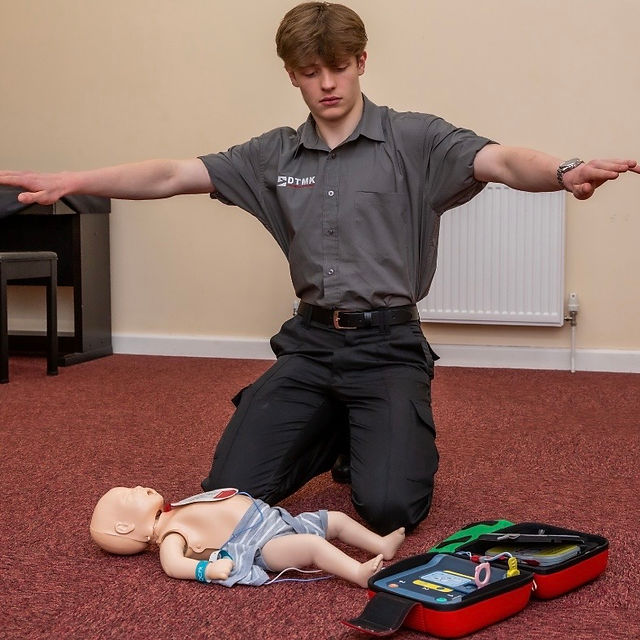


Could I Shock the Wrong Person?
This is one of the most common fears, but an AED doesn’t allow the rescuer to make the clinical decision.
After the pads have been applied, the machine analyses the electrical activity in the heart. It will only advise or deliver a shock when its programming identifies an appropriate shockable rhythm.
You cannot decide to shock someone simply by pressing the button. If no shock is indicated, the AED won’t make one available.
The greater danger is usually hesitation. Time can disappear very quickly while people debate whether they are qualified, search for someone more confident or worry about making the situation worse. An available AED should be switched on and attached as soon as possible during a suspected cardiac arrest.
The machine will decide what happens next.
Could the AED Shock the Rescuer?
The risk of accidental shock to a rescuer is low, but everyone must follow the safety instructions.
Nobody should touch the person while the AED analyses the rhythm or delivers a shock. The rescuer operating the device should look around, clearly tell everyone to stand back and visually check that nobody is in contact with the casualty.
Chest compressions should continue while the pads are being attached when more than one rescuer is present, but they must stop briefly when the AED asks to analyse the rhythm.
The machine’s prompts create a clear pattern: hands on for CPR, hands off for analysis and shock, then hands straight back on for CPR.
Practical training helps this sequence feel natural. It also shows learners how easily a hand, knee or piece of equipment can remain in contact with a casualty unless someone deliberately checks.
Can Using an AED Make Things Worse?
People often worry that they may injure someone who isn’t really in cardiac arrest. Resuscitation Council UK advises that the risk of harm from CPR is low and rescuers shouldn’t be afraid to act when cardiac arrest is suspected.
An AED adds another safeguard because it assesses the heart rhythm before making a shock available. If the rhythm doesn’t require defibrillation, it won’t advise a shock.
In a genuine cardiac arrest, doing nothing carries an obvious and immediate risk. Calling 999, starting CPR and using an available AED give the person a chance that hesitation cannot provide.
This doesn’t mean the rescuer has to feel calm or confident. Courage in an emergency often looks much less impressive from the inside. You can feel frightened, uncertain and out of your depth while still following the call handler and the machine one instruction at a time.
CPR and Defibrillation Work Together
An AED is a vital piece of equipment, but it doesn’t replace CPR.
Chest compressions help move a limited amount of oxygenated blood towards the brain and heart while the person has no effective circulation. This can help preserve the conditions needed for successful resuscitation until a shock can be delivered and professional help arrives.
High-quality CPR also improves the chances that defibrillation will succeed. This is why interruptions should be kept as short as possible.
If two rescuers are present, one can continue CPR while the other switches on the AED and prepares the pads. Compressions stop only when the machine needs everyone to stand clear for rhythm analysis and, when advised, shock delivery.
After a shock, CPR begins again immediately. The AED will tell rescuers when it is ready to analyse the rhythm once more.
CPR buys time. Defibrillation may correct a shockable rhythm. The ambulance service then provides the advanced care needed to continue the resuscitation attempt and treat the cause of the cardiac arrest.


What If I Don’t Understand the Biology?
You don’t need to.
Understanding ventricular fibrillation may be interesting, and it can help explain why a shock is sometimes appropriate. However, you don’t need to recognise the rhythm, remember its name or understand the electrical pathways inside the heart.
The practical response remains straightforward. Call 999, start CPR, switch on the AED, attach the pads and follow its instructions.
The AED handles the complicated part. It analyses the rhythm and decides whether a shock should be given. Your role is to connect the machine to the person and carry out the instructions it provides.
Training doesn’t turn members of the public into cardiologists. It makes an unfamiliar situation feel more familiar, allowing people to concentrate on useful actions instead of being distracted by the equipment.
Finding a Public Access Defibrillator
Public access defibrillators can be found in workplaces, schools, shopping areas, leisure facilities, transport locations, community buildings and other public spaces.
During a 999 call, the ambulance service may be able to identify the nearest registered and accessible AED. In the UK, this information is supported by The Circuit, the national defibrillator network.
AED owners should register their equipment with The Circuit so that ambulance services know its location and availability. Resuscitation Council UK’s 2025 guidance recommends that public access AEDs should be clearly signposted, readily accessible and housed in unlocked cabinets wherever possible.
You can also search for registered public access defibrillators through Defib Finder. Availability can change, so the ambulance service remains an essential source of guidance during a real emergency.

Real World Examples
A Cardiac Arrest in a Community Centre
A man suddenly collapses during a community event. He is unresponsive and appears to make occasional gasping sounds.
One person calls 999 while another begins chest compressions. A third person retrieves the building’s AED. They switch it on, expose the man’s chest and attach the pads as shown.
The AED asks everyone to stand clear while it analyses the rhythm. It advises a shock, which is delivered after everybody has moved away. CPR starts again immediately, following the AED and call handler’s instructions until the ambulance service arrives.
Nobody involved had to identify the rhythm. The machine completed the analysis.
An AED Says No Shock Is Advised
An employee is found unresponsive and breathing abnormally at work. Colleagues call 999, begin CPR and attach the workplace AED.
The machine announces that no shock is advised. For a moment, one colleague assumes this means they should stop.
The AED then instructs them to continue CPR. The absence of a shockable rhythm doesn’t mean the cardiac arrest has ended, so they continue chest compressions until the ambulance team takes over.
Training helps rescuers understand this message before they hear it under pressure.
A Healthcare Team Responds in a Clinical Setting
A patient becomes unresponsive in a clinical environment. Members of the team call for emergency assistance, begin CPR and bring their resuscitation equipment.
Although their roles may be more structured than those of public bystanders, the central principles remain familiar: recognise cardiac arrest, call for help, provide effective CPR and attach a defibrillator promptly.
Regular clinical BLS training helps the team practise not only individual skills, but also communication, equipment familiarity and coordinated working.
A Bystander Has Never Used an AED
A customer collapses in a busy public building. A nearby bystander has never attended first aid training, but another person arrives with an AED.
The bystander switches it on and follows each instruction. The diagrams show where the pads belong, and the machine tells everyone when to stand clear.
Lack of previous training doesn’t prevent them from helping. The AED has been designed for exactly this situation.
Why This Matters in Milton Keynes
Milton Keynes has busy shopping areas, workplaces, leisure facilities, transport routes and community venues where large numbers of people pass through every day. Public access defibrillators are becoming increasingly visible, but their presence only helps if people are willing to use them.
A green cabinet on a wall can still feel intimidating when someone has collapsed beside it. People may worry about opening it, applying the pads incorrectly or delivering a shock that wasn’t needed.
Clear information helps dismantle those fears, while practical training gives people the opportunity to handle an AED before an emergency occurs.
DTMK provides Basic Life Support and AED training for members of the public, community groups, workplaces and clinical teams in Milton Keynes. The emphasis is practical: recognising cardiac arrest, performing CPR, using the equipment and responding to its instructions.
The aim isn’t to make a simple device seem complicated. It is to make the person standing beside it feel capable of beginning.
Frequently Asked Questions
Can anyone use a defibrillator?
Yes. Resuscitation Council UK’s 2025 guidance states that anyone can use an AED and that no training is needed.
Training remains valuable because it builds familiarity with CPR, pad placement and the sequence of actions, but it isn’t a condition of using an AED during an emergency.
Will an AED shock someone who doesn’t need it?
An AED analyses the electrical activity in the heart and only advises or delivers a shock when it identifies an appropriate shockable rhythm.
The rescuer doesn’t make that clinical decision. If the machine says that no shock is advised, continue CPR and follow its instructions.
Should I call 999 before looking for a defibrillator?
If someone is unresponsive, call 999 as soon as possible. If other people are present, one person can make the call while another remains with the casualty.
Once CPR is underway, the call handler may ask whether an AED is available and direct another person to retrieve the nearest accessible device.
Does a defibrillator restart a heart that has completely stopped?
Not in the way often shown on television. Defibrillation interrupts certain disorganised electrical rhythms, giving the heart’s natural electrical system an opportunity to regain control.
Some cardiac arrest rhythms aren’t shockable. The AED identifies whether a shock is appropriate and instructs the rescuer to continue CPR either way.
What happens if the AED says no shock is advised?
Restart chest compressions immediately and continue to follow the machine’s instructions. A no-shock message doesn’t mean that the person has recovered.
The AED will normally direct rescuers to continue CPR before analysing the rhythm again later.
Do I need to remove someone’s bra to attach the pads?
Correct pad contact with bare skin is the priority. Resuscitation Council UK’s 2025 guidance says that a bra may remain in place if the pads can be positioned correctly without removing it.
If the bra interferes with correct pad placement, it should be removed. Concerns about exposing the chest shouldn’t delay life-saving treatment.
Summary
An AED is designed to be used by ordinary people during an extraordinary situation. It analyses the heart rhythm, determines whether a shock may help and provides clear instructions throughout the resuscitation attempt.
The person using it doesn’t need to understand the electrical biology of the heart. They need to call 999, begin CPR, switch on the AED, attach the pads and follow the prompts.
A shock is only made available when the machine identifies a suitable rhythm. If no shock is advised, CPR must continue. After a shock, CPR must also restart immediately.
Training isn’t required before using a public access AED, but it builds valuable familiarity. It allows people to practise CPR, handle the equipment and hear the prompts before they face the pressure of a real cardiac arrest.
The technology inside an AED is clever. Using it is intentionally simple.
CPR and AED Training in Milton Keynes
DTMK offers practical BLS and AED training for people with different responsibilities.
Our community CPR and AED training is suitable for members of the public, workplaces, volunteers and community groups who want to learn how to recognise cardiac arrest, perform CPR and use an AED.
We also provide clinical adult BLS and AED training for people working in healthcare and clinical environments. Clinical training reflects the responsibilities, equipment and teamwork found in professional practice.
DTMK also offers BLS courses covering adults, children and infants. You can compare the wider range through our community first aid courses and clinical BLS courses.
If you’re arranging training for a workplace, clinical team or community organisation, request a private course. Individual learners can check the current Milton Keynes course dates.
You don’t need a detailed understanding of heart rhythms to use an AED. Sometimes the greatest benefit of training is simply discovering that you were already capable of following its instructions.


Comments